Some days ago I read that a study was conducted on viruses in bats. This was certainly done because SARS-CoV-2 is believed to stem from bats. Although newer research found that SARS-CoV-2 is genetically closer related with corona-viruses in pangolins. However, the study of viruses in bats revealed that these viruses aren’t easily transferred from one species of bats to another. When a species of bats lives in many different areas, then these bats have the same viruses independent of the area. Different species of bats, that live closely together, have different species of viruses. So those corona-viruses don’t easily jump from one species to another!
Even some scientists seem to have been surprised by these findings. I can only wonder why. These findings were to expect! No virus could ever live without its host! Each virus consists of particles of cells of its host. Where this particles are found is the cell of the host and where the cell is found is the host. It is very difficult for a virus to establish itself in a new host, where the cells and particles within the cells could be completely different. It is the easier, the closer the new host species is genetically related with the host species already acquainted with.
It is much more likely that a virus mutates within its habitual host. This is the usual way. A virus is completely incapable of developing outside of a host! This is a very important piece of information. A consequence of it is that the common idea of viruses representing an early step of evolution is completely false. Older virus species have larger genomes than younger virus species. But it is a misinterpretation that older viruses would once have lived “more on their own” because no virus can live on its own and every virus is one-hundred percent dependent on its host. Older species of viruses consist only of larger pieces of their host cells because every virus consists only of pieces of its host cell. The viruses have developed from the cells, not vice-versa!
Another recent study found that SARS-CoV-2 has already developed into different strains. Thousands of mutations have already been identified, but SARS-CoV-2 can be clearly divided into three main strains.
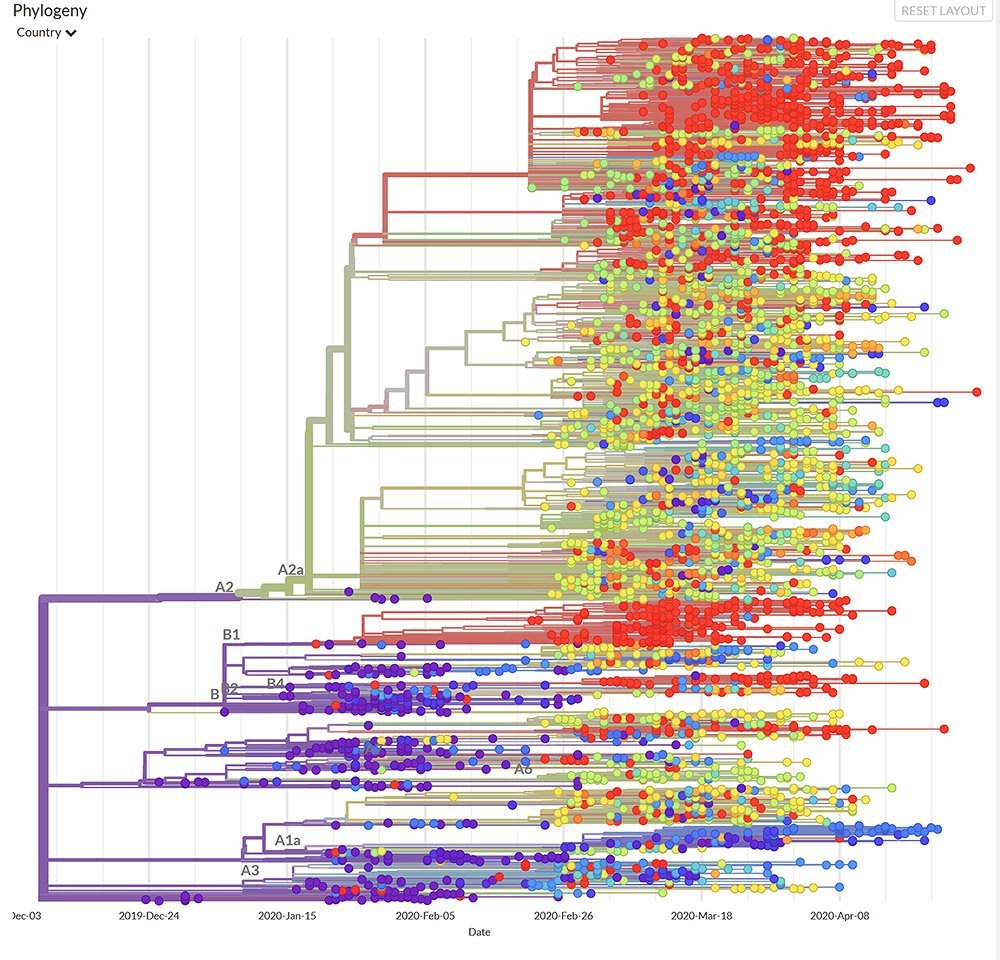
Strain A is already different from any corona-virus in bats, what isn’t surprising anymore because meanwhile pangolins are thought to be the source of SARS-CoV-2, but strain A is found in Wuhan and had spread from there over the east of Asia and into North America. Most widespread in Asia is strain B, that also came to North America and to Europe, where it is found only in a minority of patients. Europe deals mainly with strain C, which is a mutation from strain B. This strain could even be traced from Italy into Brazil. Most mutations have no effect and need only to be considered in the categorization of viruses. The Arizona State University has identified a mutation, which consists of the loss of 81 RNA-bases resulting in the loss of 27 amino-acids in a protein, which kills the host cell. This reflects the usual course of the development of a virus because viruses need their hosts alive! It also means that the North American strains of SARS-CoV-2 are probably even more harmless than other strains. Would this be reflected in the official numbers on the pandemic, then the USA would have to report a lower fatality rate than all other countries! But the mapping of the mutations also busts the new Chinese narrative that SARS-CoV-2 must have been present in the USA already before it came to Wuhan. This is only political propaganda in response to the political propaganda of the USA that China should be held responsible for everything, which happened inclusively outside of China.
 Phoibe
One thought on “Understanding Viruses”